

Mangrove Plastics Removal
Outcomes for Vital Ecosystems
Mangrove Plastics Removal
Outcomes for Vital Ecosystems
A first-of-its-kind citizen science study of how plastic pollution, and its removal, affect mangrove restoration, biodiversity, and ecosystem health in Indonesia.
M-PROVE is working to gain evidence that supports

Biodiversity conservation

Community-led waste mitigation strategies

Ecosystem resilience

Sustainable coastal communities.
40%
of Indonesia’s mangroves were lost
over the three decades leading up to 2015
40%
of Indonesia’s mangroves were lost
over the three decades leading up to 2015
How Plastic Pollution Affects Mangrove Ecosystems
Ocean nursery
Coastal fisheries depend on juvenile fish and invertebrates sheltered by mangrove roots.
Storm defense
Intricate root systems absorb the force of storms before they reach shore.
Rising seas
Mangroves build up wetland soil elevation, keeping pace as sea levels rise.
As the climate crisis accelerates, mangroves are among our most important natural coastal defenses. Yet plastic pollution carried downstream from rivers and coastal settlements is threatening these mangrove forests.
Plastic debris overtakes seedlings, entangles and deforms roots, blocks photosynthesis, and alters soil chemistry and hydrology – degrading habitats for the species that depend on them.
While cleanup programs remove tons of waste every year, this is a ground-breaking experimental study that combines biodiversity monitoring with field experiments to test how removing plastic affects mangrove recovery.
Our Mangrove Conservation Partners in Indonesia
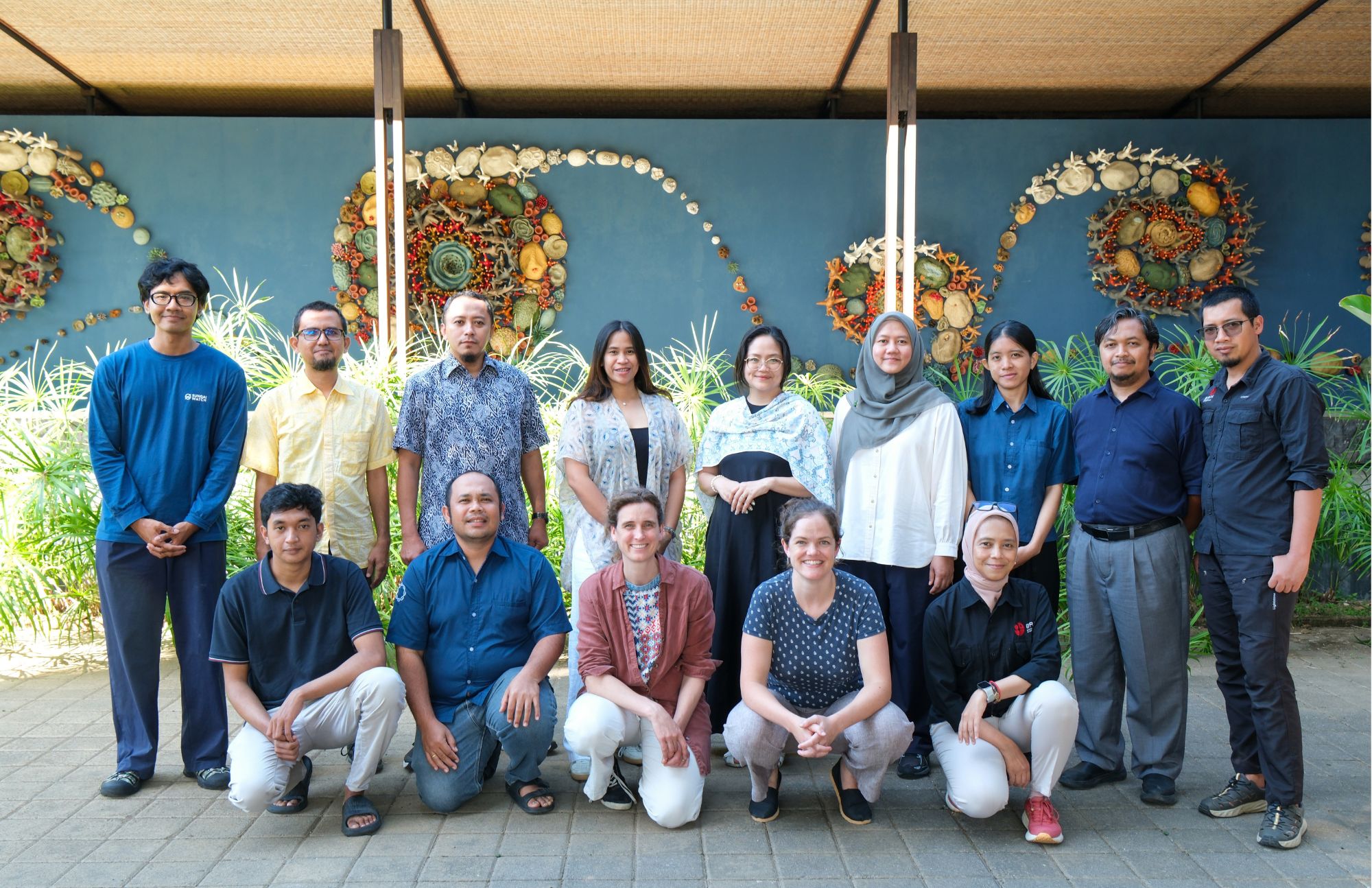
Co-led with Indonesia’s National Research and Innovation Agency (BRIN) and implemented by Indonesian research, conservation, and community organizations, with international scientific partners.
Learn more about the M-PROVE Partnership
Co-led by Adventure Scientists and the Republic of Indonesia’s National Research and Innovation Agency (BRIN), which serves as scientific lead for Indonesian research components. Adventure Scientists serves as co-lead and project manager. Field data collection is carried out by Sungai Watch field teams and community members, with biodiversity surveys supported by students from Udayana University. Partner institutions include:
- Sungai Watch: Bali-based NGO tackling plastic pollution through river barriers and cleanups; leads field cleanups, monitoring, community engagement, and public outreach.
- Bionesia: Bali-based research and conservation nonprofit specializing in eDNA extraction and biodiversity monitoring; leads the project’s eDNA team.
- MATA Nusantara: Bali-based community foundation with long-standing experience in mangrove ecology and restoration; local implementing partner for forest structure, regeneration, and soil carbon fieldwork.
- NatureMetrics: Global leader in environmental DNA analysis; provides sequencing, biodiversity assessment, and data visualization.
- Wageningen University & Research: Provides scientific guidance on plastics–mangrove interactions, site selection, and methodological development.
Measuring the Ecological Impact of Mangrove Cleanup
Removing plastic from mangroves is important, but does it actually help the ecosystem recover?
By measuring changes in biodiversity, ecosystem health, and mangrove recovery over time, M-PROVE is intended to provide the evidence needed to understand what impact plastic — and removing it — really has on mangrove ecosystems. That evidence can help guide future conservation efforts, such as community-led cleanup and waste management programs, river-interception systems, investment opportunities, and broader initiatives that reduce plastic pollution.
Better conservation starts with better evidence.
“The major a-ha moment was realizing that plastic monitoring, forest structure, soil, biodiversity, and community knowledge should not be treated separately, because each provides part of the same story. The program can produce results that are both scientifically meaningful and useful for the communities protecting these mangroves.”
Community-Based Mangrove Restoration and Plastic Monitoring
Leveraging international expertise to increase local capacity across 8 organizations: Government science, grassroots cleanup work, global eDNA labs, local conservation groups, and local universities all measuring the same sites the same way.
Rigorous experimental design: Three mangrove sites across a gradient of plastic pollution — heavy, medium, and low — plus a HyperClean experiment that compares intensive plastic removal in some plots with untouched control plots.
Community-powered data at scale: Local community members and practitioners are trained as data collectors, generating high-integrity datasets while building lasting national capacity.
Support Mangrove Plastics Removal & Vital Ecosystems
You can support the fieldwork, the community training, and the analysis that turns raw field data into evidence that conservation groups and governments can act on.
Looking to bring mangrove plastic research to your region? Partner with us.
Frequently Asked Questions
What is M-PROVE?
M-PROVE stands for Mangrove Plastics Removal: Outcomes for Vital Ecosystems. The research study engages communities and science to measure how plastic – and its removal – restores mangrove health, biodiversity, and climate resilience in Benoa Bay, Indonesia. M-PROVE is co-led by Adventure Scientists and Indonesia’s National Research and Innovation Agency (BRIN) in collaboration with leading local researchers and community practitioners, as well as global academic and technical partners. The project combines field data collection with rigorous ecological science to determine whether reducing plastic pollution helps restore mangrove ecosystem health. It is a project to generate evidence that supports biodiversity conservation, community-led waste mitigation, ecosystem resilience, and sustainable coastal communities.
How does plastic pollution affect mangroves?
Plastic carried downstream from rivers and coastal settlements accumulates in mangrove forests, where the same root systems that trap sediment also trap waste. Debris smothers seedlings before they establish, entangles and deforms roots, and blocks the light and gas exchange mangroves depend on. It can also alter soil chemistry and hydrology, changing conditions below ground as well as above.
Why are Indonesia's mangroves important?
Indonesia holds the largest and most diverse mangrove ecosystem on Earth — roughly 2.95 million hectares, more than 20% of the world’s remaining mangroves. These forests are among the most carbon-rich ecosystems on the planet. They shelter the juvenile fish and invertebrates that coastal fisheries depend on, absorb storm energy before it reaches shore, and build up wetland soil elevation as sea levels rise. While some areas remain relatively intact, mangroves in densely populated regions like Java and Bali have been severely degraded.
Mangroves not only protect communities from the impact of climate change, they play a vital ecological and economic role for coastal communities. Around 60% of Indonesia’s population lives in coastal areas and rely on mangrove ecosystems for food security and livelihoods, from fishing and sustainable firewood collection to ecotourism.
Can removing plastic restore mangrove ecosystems?
That is the question M-PROVE was built to answer. Cleanup programs remove significant volumes of plastic every year, but no large-scale experimental study has measured whether that removal translates into ecological recovery. M-PROVE tests this question directly. The project monitors the accumulation of plastic and tracks biodiversity, forest regeneration, and soil carbon across sites with different levels of plastic, as well as in a control site where plastic has been intensively removed. Results may vary by site, season, and species, and we will report what we find throughout this nearly 2-year long study.
What is eDNA monitoring?
Every organism sheds traces of DNA into its surroundings into water, sediment, and soil. Environmental DNA (eDNA) monitoring collects those samples and sequences them to identify which organisms may be present, based on genetic material in environmental samples. It picks up organisms that traditional surveys routinely miss which matters in mangroves where much of the life is small, cryptic, or below the waterline. On M-PROVE, Bionesia handles extraction in Bali, and NatureMetrics does the sequencing and biodiversity analysis. We pair eDNA with traditional biodiversity surveys to give complementary views of biodiversity in the mangroves.
How can organizations support mangrove restoration?
Funding the research directly supports fieldwork, community training, and the analysis that turns raw field data into usable evidence, and because M-PROVE runs across multiple seasons, recurring support helps sustain long-term monitoring. Your support would thereby strengthen datasets to better understand recovery over multiple seasons. Organizations can also partner with us.
Are you interested in bringing this collaborative mangrove and plastic monitoring project to your region? We’re interested in working with companies, foundations, local community organizations, and institutions focused on ocean and river plastic, blue carbon, mangrove regeneration, and nature-based solutions. Use the link above to start a conversation.
What does M-PROVE actually measure?
The study looks at how plastic — and its removal — affects mangrove ecosystem health, regeneration, recovery, biodiversity, and soil carbon. It combines five methods across the same sites: traditional biodiversity surveys, eDNA sampling, plastic accumulation monitoring using a phone-based tool built for citizen science, forest structure and regeneration (seedlings, saplings, and root condition), and soil carbon measurements to see how much carbon is stored across the sites and whether it changes over time. Running all five together is what makes it possible to connect plastic levels to actual ecosystem response, rather than measuring any one signal in isolation.
Why compare sites with different amounts of plastic instead of cleaning them all?
M-PROVE studies three representative mangrove sites across a gradient of plastic pollution — heavy, medium, and low — which is what makes it possible to see how the ecosystem responds at different levels of contamination. Within one of those sites, a HyperClean plots where plastic is intensively removed is compared with control plots that get no experimental removal. Sungai Watch’s efforts to stop plastic pollution from entering the oceans protect and restore Indonesia’s rivers through barriers and community clean-ups continues throughout the region, and this study measures what that work actually accomplishes.
Is this just funding a research paper instead of real-world cleanup?
The data itself is the deliverable that unlocks real-world action. It’s designed to give local communities, governments, funders, and blue-carbon financing mechanisms the evidence they need to invest in cleanups, helping communities and funders see where plastic cleanup makes the biggest difference for mangroves, and how to make those efforts more effective. M-PROVE funds Sungai Watch’s on-the-ground cleanup work as part of the study. This project not only measures the impact of community clean-up efforts; it also trains, engages, and compensates Sungai Watch staff to monitor, clean up, and recycle plastic accumulation in mangroves.
What if the data shows cleanup doesn't actually work?
What qualifies Adventure Scientists to do this work?
Adventure Scientists has designed and managed large-scale field data collection projects for conservation partners since 2011, activating trained volunteers and local communities to collect scientific data that’s otherwise too remote, costly, or large-scale to gather. Our Coral Reef Monitoring project — a similar multi-country, multi-partner model — has completed more than 2,400 reef censuses and trained 80+ volunteers across four countries in just one year.
What is BRIN? What are their qualifiers for their work?
BRIN, Indonesia’s National Research and Innovation Agency, coordinates the country’s research, innovation, and development infrastructure. As M-PROVE’s co-lead, BRIN ensures the project’s findings carry direct weight with local and national policymakers who set Indonesia’s mangrove and waste-management strategy, rather than sitting in an academic journal a ministry may never see.
BRIN’s role includes:
- Policy translation: BRIN researchers will publish evidence-based policy briefs that turn scientific findings into actionable recommendations for waste management, mangrove protection, and ecosystem recovery across Indonesia and the wider Coral Triangle region.
- Governance oversight: BRIN ensures the project complies with Indonesian research governance and data-access policies, while supporting appropriate access to findings for funders and future nature-financing initiatives.
- Institutional pathways: BRIN determines the appropriate channels for engaging government agencies and regional institutions.
Is my donation tax-deductible, and is it one-time or recurring?
Adventure Scientists is a registered 501(c)(3) nonprofit, so donations are tax-deductible to the extent allowed by law. You can give once or set up a recurring monthly gift — recurring support is especially valuable on a multi-year study like this one, where fieldwork runs across seasons through 2028.